cck_image_upload: 
Publications

Publications

Reports | Factsheets | Submissions | FYI | Election Questionnaires

You can order copies of pamphlets by clicking here.


Reports

Energizing the Drummond Report: How Ontario can reap multi-billion dollar electricity savings: Ontario's electricity bills can be reduced by $1.7 billion to $9.1 billion per year by 2030 by importing water power from Quebec and investing in energy efficiency and natural gas-fired combined heat and power plants instead of continued wasteful spending on nuclear power. 

An Energy Efficiency Strategy for Ontario’s Homes, Buildings and Industries: Ontario can lower residential and industrial energy bills, reduce the provincial deficit and create jobs by increasing its energy productivity according to this new OCAA report. Click here for the Executive Summary.

The Economic Impacts of Reducing Natural Gas Use in Ontario: According to a companion report to the Energy Efficiency Strategy (above) prepared by Dr. Ernie Stokes of the Centre for Spatial Economics, energy efficiency investments that reduce the outflow of Ontario dollars to Alberta to purchase natural gas will lead to a net increase of 12,200 to 33,800 jobs per year in Ontario between 2016 and 2021. The energy efficiency investments will also reduce Ontario’s provincial deficits by $159 million to $479 million between 2016 and 2021.

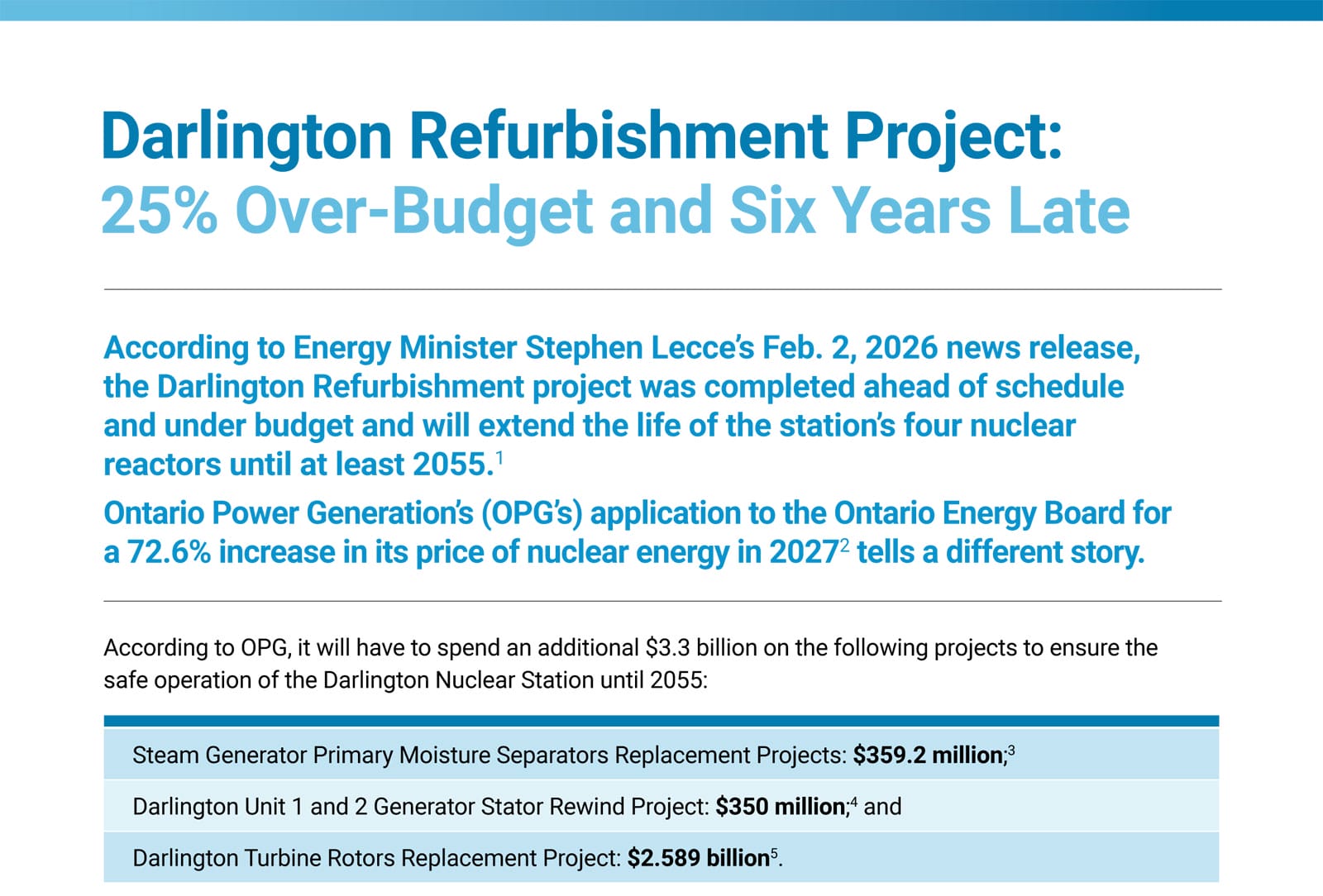
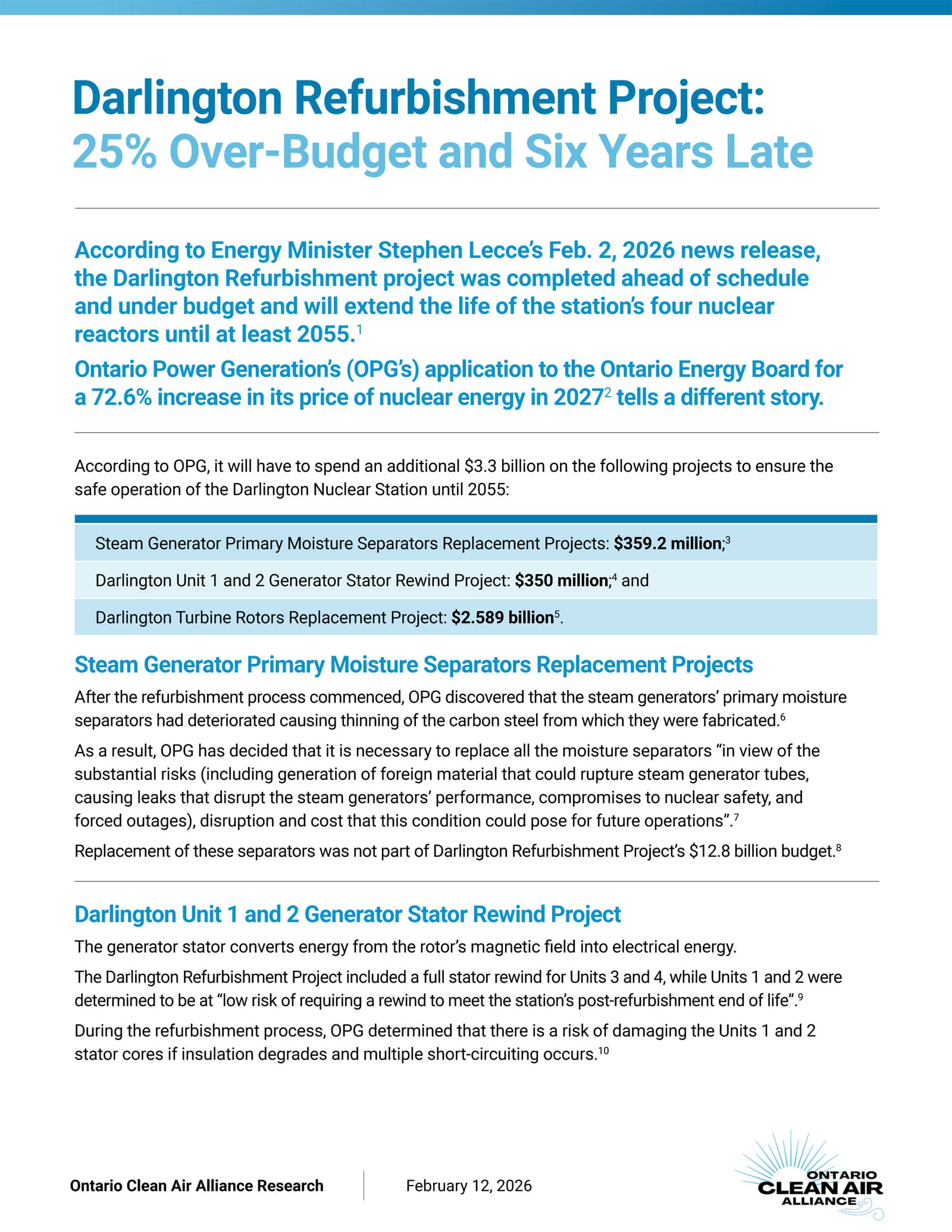
Darlington Re-Build Could Cost $21 to $35 Billion: OPG is seeking permission from the Ontario Energy Board to raise its rates commencing March 2011 to start paying for the Darlington Re-Build project. According to OPG, its proposal to extend the operating life of Darlington by 30 years will cost $8.5 to $14 billion. However, as this OCAA report notes, every single nuclear project in Ontario’s history has gone over budget and the actual costs of Ontario’s nuclear projects have been 2.5 times greater than the original cost estimates.

Higher Profits and Lower Bills: A New Electricity Strategy for Hydro Quebec – Hydro Quebec’s profits will fall by 24% and its rates will rise by 8% according to this new report released by Equiterre and the Ontario Clean Air Alliance (OCAA). Having developed all of the province’s low-cost hydro-electric resources, Hydro Quebec can no longer increase its profits and lower its rates by building new low-cost hydro facilities. For the French version, please click here.

Finishing the coal phase-out: An historic opportunity for climate leadership (revised) – Ontario’s coal-free generation capacity is now 29% greater than the province’s projected peak day demand in the summer of 2012 and 35% greater than its forecast peak day demand in 2014.  As a consequence, we no longer need our dirty coal plants to keep the lights on in Ontario or to ensure a reliable electricity supply.

Powerful Options: A review of Ontario’s options for replacing aging nuclear plants – This report discusses how hydro-electricity imports from Quebec and the development of the Lower Churchill Falls Project in Labrador can replace Ontario’s aging nuclear.

The Power of Mutual Benefit – Increased electricity trade between Ontario and Quebec could provide the two provinces with economic benefits in excess of $1 billion per year according this new OCAA report. The Power of Mutual Benefit, outlines the many benefits of interprovincial energy trade and building a sustainable Canadian energy sharing strategy that meets social and environmental goals.

Coal phase out within our grasp – Ontario can idle its dirty coal plants five years ahead of the government's official Dec. 31, 2014 deadline.There is a tremendous opportunity to take action on climate change now by taking coal offline by 2010. As this report outlines, we have the power, we just need a farsighted decision to act now.

Tax Shift – Eliminating Subsidies and Moving to Full Cost Electricity Pricing. This new report from OCAA Research Inc. outlines how Ontario can improve productivity and reduce pollution by shifting money spent on electricity subsidies to a new consumer rebate.

The Ontario Power Authority's Coal Phase-out Strategy: A Critical Review – This report looks at the Ontario Power Authority's plan for meeting the province's 2014 coal phase out deadline and suggests how the plan could be improved to allow a full coal phase out by 2010.

Increasing productivity and moving towards a renewable future: A New Electricity Strategy for Ontario – This in-depth report looks at how Ontario can increase prosperity, and improve health and our environment while making its industries more competitive by focusing on rewarding efficient electricity use instead of subsidizing inefficient production and consumption.

Read our reports on the proposed gas plant in Northern York RegionThe Ontario Government has proposed a large 350-400 megawatt simple cycle gas plant to meet the power needs of Northern York Region. This low-efficiency plant will cost hundreds of millions of dollars and will operate on only a handful of very hot summer days. Read more.

More Reports


Factsheets

A Seven Point Plan for Premier Wynne

The OCAA has seven ideas for how Premier Wynne can remake Ontario’s electricity system as a lean and efficient service machine. The seven points range from reducing peak demand by increasing participation in the underused peaksaver program to increasing use of combined heat and power technology. These seven steps are the key to unlocking both cost savings and increased productivity in Ontario and we hope the Premier will act on each and every one of them. 

 A Case for Accelerating the Rollout of Small-scale Combined Heat and Power (CHP) Projects Through a CHP Case Study

– Ontario’s local electric utilities say they need billions of dollars in investment and will be seeking higher prices to raise the money. There is no doubt that Ontario’s electrical infrastructure must continue to be modernized and maintained yet could these billions of taxpayer and ratepayer dollars be used efficiently? This case study gives an example of a small-scale, distributed, natural gas Combined Heat and Power (CHP) Plant and suggests how this option can play a significant role in the solution to Ontario’s energy dilemma. 
 
 
The OCAA's Air Quality Issues factsheet series provides a concise overview of some the key issues around electricity generation and use in Ontario.

Featured factsheets

Conservation vs. Electricity Supply – This updated factsheet (June 2012) summarizes the Ontario Power Authority's spending on new supply sources compared to its spending on efficiency and conservation methods. OPA has entered contracts for 21,039 megawatts (MW) of electricity supply yet its conservation and demand management programs are reducing demand in 2011 by approximately 1,230 MW. For every MW of demand reduction that it has reported, the OPA has contracted for 17 MW of electricity supply.

Toronto on the Electricity Edge – Toronto currently generates less than 2% of its own power.  If we want to keep the City's lights on, we need to rapidly increase distributed power generation throughout the city, in large part through the use of combined heat and power systems.

Places of Power - Advancing Combined Heat and Power in the Institutional and Municipal Sector – This 8-page factsheet looks at combined heat and power (CHP) applications for everything from hospitals and universities to wastewater treatment plants.  It also profiles the City of Markham's groundbreaking district energy system, which has a major CHP component.  This is the second in our series of factsheets examining how Ontario can increase the use of highly efficient CHP to replace dirty coal fired electricity.

Ontario's Impending Nuclear Monopoly  – If the Ontario Government proceeds with its current plan to acquire up to 14,000 megawatts of power from new and refurbished nuclear reactors, nuclear power will dominate Ontario electricity's supply, providing up to 72% of the province's power.  Our factsheet outlines a fairer and more balanced approach to meeting Ontario's electricity needs.

Towers of Power –  Advancing combined heat and power in multi-residential buildings. CHP systems can provide big advantages – not the least of which is significantly reduced greenhouse gas emissions.

Replacing coal-fired electricity – Ontario has secured large quantities of new supply, but needs to pick up the pace on conservation and demand management.

More Factsheets


Submissions and presentations

This section contains OCAA submissions to government agencies, such as the Ontario Power Authority and Ontario Energy Board, as well as copies of OCAA presentations to various forums.

Go to Submissions


FYI

This section contains materials from other organizations with useful information about the coal phase out, air pollution and electricity issues.

Go to FYI


Election Questionnaires

Will Tim Hudak stand up for Ontario's hard-working families? Premier Dalton McGuinty, NDP Leader Andrea Horwath and Green Party Leader Mike Schreiner have all promised that they will not allow nuclear power companies to pass their future cost overruns onto Ontario’s consumers and taxpayers in their responses to an Ontario Clean Air Alliance (OCAA) election questionnaire released today. Click here to read the 2011 Ontario Election responses.


NDP, Bloc and Greens oppose taxpayer subsidies for new Ontario nukes: To view the political parties full responses to the OCAA 2011 federal election questionnaire click here.

The OCAA has questioned provincial and federal election candidates on issues such as coal phase out deadlines and the East Toronto Transmission Line.  Their responses are posted here.

Go to Questionnaires

Ontario can idle its dirty coal plants five years ahead of the government's official Dec. 31, 2014 deadline.There is a tremendous opportunity to take action on climate change now by taking coal offline by 2010. As this report outlines, we have the power, we just need a farsighted decision to act now.